
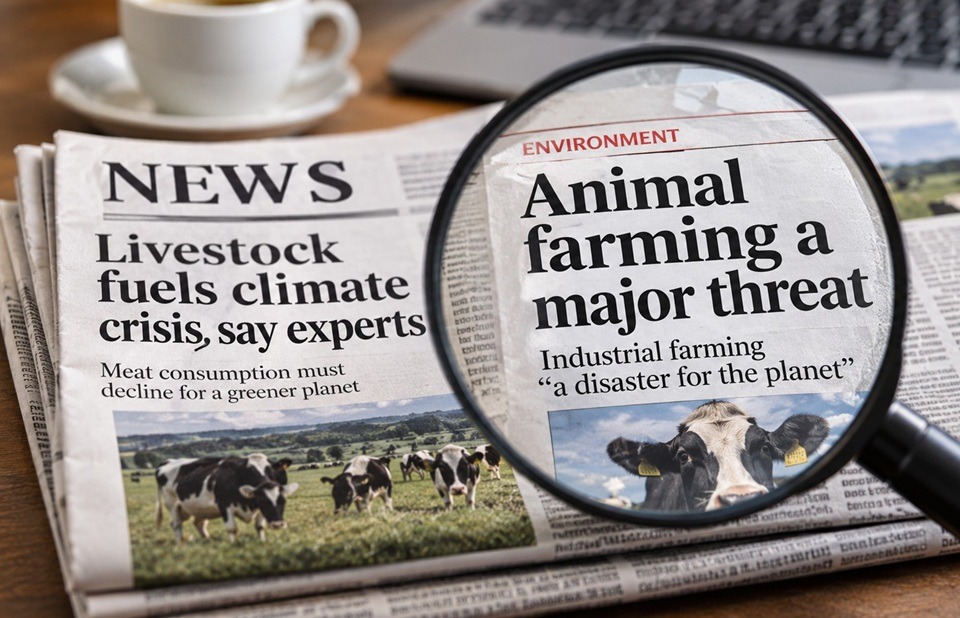
When simplification becomes disinformation
From fake news to half-truths: how loss of context and excessive simplification can distort the public debate on livestock farming and push consumers’ perception away from the complexity of scientific reality.
- It doesn’t take false news to misinform. Even accurate information, stripped of context or presented selectively, can generate a misleading representation of reality.
- Livestock farming is a complex system. Environment, nutrition, genetics, animal welfare and economics are interconnected dimensions that cannot be reduced to simplistic oppositions between good and bad.
- Good science communication simplifies without trivialising. To counter disinformation, scientific evidence must be made understandable, uncertainties made explicit, and data distinguished from interpretation.
Livestock farming is a complex system in which biology, nutrition, genetics, the environment, animal welfare, economics and social relations intertwine. Yet when farms enter public debate, this complexity is often reduced to elementary oppositions: natural versus artificial, local versus industrial, good versus bad.
These categories work well in communication because they allow information to be organised quickly and messages to be built that are immediately understandable. But they are far less effective when they have to describe reality. The problem arises when, to make a topic easier to understand, essential aspects are stripped away, leaving an incomplete or misleading picture of reality.
You don’t need completely false news to misinform
We are used to identifying disinformation with fake news: invented data, images taken out of context, sensationalist headlines and deliberately manipulated claims. That is part of the problem, but today it is no longer enough to focus on explicit falsehoods. There is a form of distortion that is harder to recognise: misinformation, that is, the spread of inaccurate or misleading information even by people with no intention to deceive. A news item can originate from deliberate manipulation and then be shared by thousands of users convinced of its reliability.
In other cases, the problem is even subtler. A statement can be substantially correct and yet become misleading because it is stripped of the context needed to interpret it. It is enough to select some data, omit others and place them within an apparently coherent narrative to change the overall meaning of the information. This mechanism is particularly relevant when talking about farms and animal production, because these topics closely affect our health, what we eat, the environment we live in, and how we consider animals. Precisely because they involve such sensitive aspects, information is easily interpreted through emotions and personal convictions, rather than assessed in context.
From scientific data to public perception
Scientific information goes through several stages: it originates in research, is reported by the media, reaches the public and can influence people’s choices and institutional decisions. At each stage, some information is selected and explained in simpler terms. This is inevitable: a newspaper headline or a short social media post cannot contain every detail of a study. The problem arises when, to make the message more immediate, its meaning is changed, the remaining doubts are ignored, or a result that is valid under certain conditions is presented as if it were always true and applicable to everyone. Explaining science clearly does not mean eliminating all complexity, but helping people understand the results without concealing their limitations.
In the livestock sector, how information is communicated can influence consumer trust, companies’ choices, the development of new technologies, and institutional decisions. Moreover, many people today are far removed from the places and processes where food is produced. This distance can make it harder to understand how a farm works and which factors affect its impact. As a result, the debate risks focusing on simplistic judgements, for example, considering a product or a farmer “good” or “bad”, instead of concretely examining production methods, farming conditions and the available data.
Why correcting a news item is not always enough
When we receive information, we do not always remember all the details: we often retain mainly the core message. If that message aligns with what we already think or know, we tend to consider it credible more easily. Emotions, personal experiences and the trust we place in the person or source communicating it also influence our judgement. For this reason, it is not always enough to respond to false information with correct scientific data. The way we interpret facts also depends on our convictions and how we connect different pieces of information. We can therefore continue to believe a misleading claim even when data casting doubt on it are presented.
Social networks can reinforce this mechanism too. We often come into contact with people who share our ideas and see the same information and the same opinions repeated over and over. In this way, we end up encountering fewer different points of view and having fewer opportunities to question what we think. When the same version of the facts is repeated many times, it can end up seeming true to us not because it has been verified, but because it has become familiar.
Less confrontation, more science
How can we tackle disinformation about livestock farming? It is not enough to answer a negative narrative with a positive one: that would mean using the same mechanism, merely changing the point of view. The goal should be different: helping people understand the facts, making scientific information accessible, explaining what we do not yet know with certainty, and distinguishing data from opinions.
Universities, institutions, associations, and companies in the livestock supply chain share a responsibility: to communicate clearly, without hiding the complex aspects of reality. There is no need to present every technical detail of a study to the public, but it is important not to leave out the information needed to understand its results correctly. Communicating well means making science understandable without turning it into an overly simple or incomplete version of reality.
We need to move beyond narratives to help people evaluate information, verify its reliability, and consider points of view other than their own. This is not about convincing everyone to think the same way, but about offering the tools to form an opinion based on reliable knowledge. The ability to build shared knowledge grounded in scientific evidence will be essential to improving dialogue between the world of livestock farming and society.