
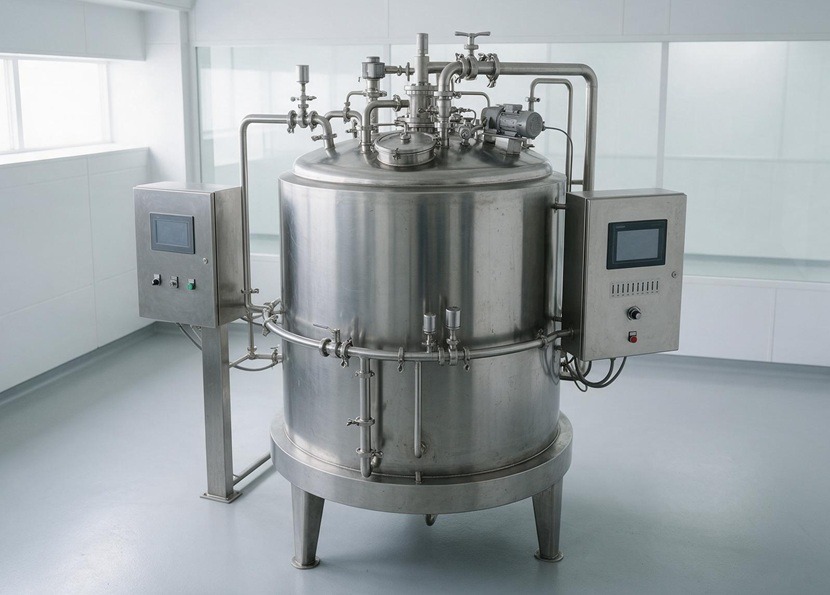
Meat and milk in bioreactors or through traditional production?
Is protein production in bioreactors really more sustainable than traditional production? A study by the Catholic University of the Sacred Heart, supported by the Italian Ministry of Agriculture, Food Sovereignty and Forestry (MASAF), challenges this assumption and highlights environmental, production-related, and nutritional concerns.
- Environmental impact: In the study, experimental production of β-casein in a bioreactor had an environmental impact more than 40 times higher, by weight, than the traditional product.
- Yields remain insufficient: The experiment produced only 0.3 grams of β-casein per litre of culture medium over 72–90 hours, highlighting the technology’s production limitations under the conditions examined.
- Nutrition and food complexity: Reproducing a single protein is not the same as recreating an entire food. The food matrix and the diversity of tissues and nutrients remain unresolved challenges for laboratory-based production.
Bioreactors or livestock farming: which is more sustainable? For now, knowledge and expertise developed over millennia of agricultural practice and scientific research still seem to have the upper hand over laboratory-manufactured animal products. Further evidence comes from a study by the Faculty of Agricultural, Food and Environmental Sciences at the Catholic University of the Sacred Heart, with support from MASAF, comparing consumer safety, environmental impacts and nutritional values of proteins produced in bioreactors. Traditional production using high-tech facilities outperforms bioreactor production. Innovation and research support sustainability and technological progress, but the data must speak for themselves.
Disappointing yields nd environmental impacts
The findings come from an independent study coordinated by Pier Sandro Cocconcelli, Full Professor of Microbiology and Rector of the Institute for Advanced Science for Agriculture (IASA), a special university-level institution established in 2026 and dedicated to research and doctoral training in agri-food systems. The research examined the experimental production of bovine β-casein (A2 variant) in pilot-scale bioreactors, using precision fermentation with genetically engineered yeast. Under these conditions, the results showed very low yields and significant environmental impacts.
The experiment achieved a yield of just 300 mg of product per litre of culture broth over 72–90 hours. In other words, 0.3 grams. High-tech proteins also have a greater environmental impact. The study assessed environmental impacts using Life Cycle Assessment (LCA), which evaluates a product’s environmental footprint throughout its life cycle, from production to disposal, often described as “cradle to grave.” The analysis found that laboratory reactors are not exactly low-impact systems.
Perceived sustainability versus the data
“The greater sustainability commonly attributed to these biotechnological approaches is absolutely not demonstrated by the data. On the contrary, the findings show that these approaches require such substantial inputs and energy consumption that their overall environmental impact is more than 40 times higher, for the same weight of product, than that of a traditional product,” says Luigi Lucini, Dean of the Faculty of Agricultural, Food and Environmental Sciences at the Catholic University of the Sacred Heart. “Beyond the energy required to operate the fermenter, the second critical issue concerns the chemical inputs needed for cell growth.”
Certainly, as Lucini also acknowledges, these technologies are scientifically exciting. He continues: “The drive toward these solutions stems from concern for animal welfare. However, when considering the inputs required to grow cells, we cannot completely disentangle the process from components that still originate from animals. Laboratory approaches are by no means entirely independent of the use of animal tissues or animal-derived inputs.” Consumers tend to perceive these technologies as environmentally friendly, partly because livestock farming is often the subject of misinformation. However, when the figures are examined, it becomes clear that more public information and awareness are needed to understand that these products are not free of environmental impacts.
The environmental impacts of bioreactors
These findings are relevant to the broader literature on bioreactors used to produce artificial meat, also known as synthetic meat. According to estimates developed by Professor Giuseppe Pulina, Full Professor of Ethics and Sustainability of Livestock Farming in the Department of Agriculture at the University of Sassari and President of Carni Sostenibili, emissions from artificial meat range from 2.5 to 13.6 kg of CO₂ equivalent per kilogram of product, depending on whether renewable or conventional energy sources are used.
According to FAO projections, global meat production is expected to increase by 44 million tonnes by 2030 compared with 2021, driven by a 14% increase in global consumption. “To meet this additional demand entirely through cultivated meat, an estimated 147,000 bioreactors with a capacity of 20,000 litres each would be required. Assuming an emissions intensity of 8 kg of CO₂ equivalent per kilogram of cultivated meat, this would result in an estimated 352 million tonnes of CO₂ equivalent, compared with 150 million tonnes attributed to the increase in livestock production,” concludes Professor Pulina.
The complexity of nutrients
Laboratory-grown meat also raises a nutritional issue related to the complexity of whole foods. Elisabetta Bernardi, a biologist and nutritionist, explains: “Producing an isolated protein does not mean reproducing the same nutritional characteristics as the complete food. In milk, in particular, nutrients are organised within what is known as the ‘food matrix’, a fundamental structure that significantly enhances nutrient bioavailability.” Food is a complex structure that technology is still far from reproducing. The same applies to cultivated artificial meat, Bernardi continues: “In the laboratory, tissue is produced from cells, but natural meat consists of a complex range of tissues, muscle, connective tissue and others, that are difficult to reproduce.”
Scientific research is an investment in the country, and its outcomes, even when unpredictable, can drive innovation. “At present, there are no studies demonstrating that laboratory-produced foods are harmful. However, from a nutritional perspective, we can already conclude that relying exclusively on products obtained through fermentation could lead to nutritional deficiencies“, the biologist concludes.


