
Dublin Declaration Desk: scientific evidence for the debate on meat
The new weekly Dublin Declaration publication brings data and research on nutrition, the environment, and livestock farming to the forefront of the debate.
- The Dublin Declaration Desk was created to make scientific evidence on nutrition, the environment, and the role of livestock accessible, providing data and sources for decision-makers.
- The future of food cannot be assessed through a single indicator, such as greenhouse gas emissions: nutrition, health, land use, biodiversity, rural economies, and food security are interconnected dimensions.
- Following the science means engaging with the full body of evidence, including uncertainties, conflicting findings, and differences between production systems and geographical contexts, without selecting only the studies that support a particular position.
In the debate over meat and livestock farming, positions are often presented through very stark oppositions: animal versus plant, meat versus the environment, livestock versus climate. But the scientific reality is far more complex. The Dublin Declaration, launched in 2022 and voluntarily signed by more than 1,200 scientists, starts from a simple principle: when decisions concern nutrition, the environment, and agri-food systems, what should matter above all is the quality of the available evidence. Not the identity of the scientist presenting it, not the ability of a particular argument to go viral, nor its greater or lesser popularity. To contribute to this discussion, the Dublin Declaration Desk is being launched, a new weekly publication promoted by some of the co-initiators of the Dublin Declaration.
Every Thursday, it will publish an article examining the scientific evidence on nutrition, the environment, livestock farming, and society, and interpreting what that evidence means for decision-makers. The scientists will write the articles in accessible language: “based on science, but not as science.” The Desk brings together eight co-authors from four continents, with expertise ranging from medicine to food science, from pasture ecology to agricultural economics. The contributors will therefore change from week to week, while maintaining a shared commitment to scientific evidence. The approach is deliberately open to discussion: comments on the articles are intended as a working space where data, observations, and perspectives from different countries and contexts can be brought forward. Its launch is therefore more than creating a new communication channel. It is an opportunity to bring a fundamental question back to the centre of the debate: how should science be used to address complex issues such as the future of food?
The “Carbon Tunnel Vision”
One issue the new Dublin Declaration Desk will address is what has been described as “Carbon Tunnel Vision”: focusing almost exclusively on greenhouse gas emissions while losing sight of everything else happening within the food system. A food product should also be assessed in terms of its nutritional contribution, protein quality and micronutrient content, water and land use, effects on biodiversity, ability of agricultural systems to make use of resources that are not edible by humans, the economic and social role of livestock farming, and the capacity to provide nutritious food to a growing global population. This means properly measuring the environmental impact of livestock farming and relating it to the functions that livestock systems perform. The scientifically relevant question, therefore, is not simply “How much CO₂ does this food produce?”, but rather: “What combination of foods and production systems can meet the nutritional needs of the population while minimising overall environmental pressures?” It is a more difficult question. But it also better reflects the complexity of the problem.
There is no single livestock farming system
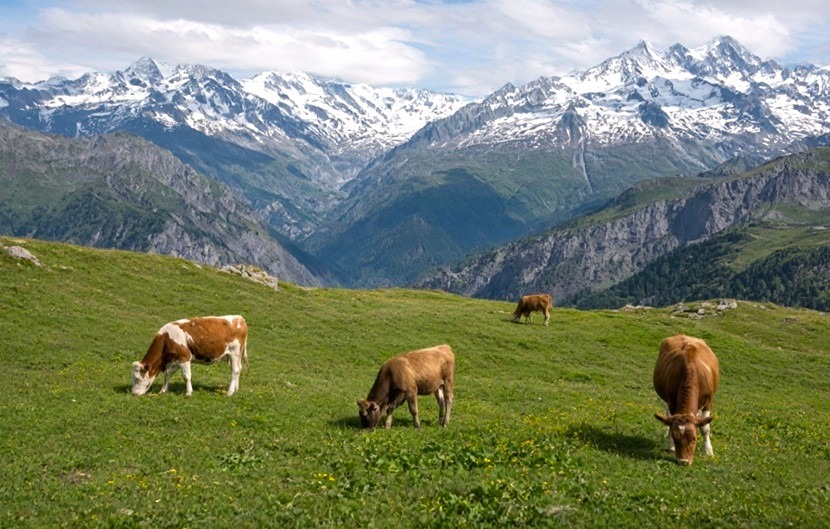
Another frequently overlooked element is the extraordinary diversity of livestock systems. Putting together a precision-managed cattle farm, an extensive grazing system, a Mediterranean farm integrated with crop production, a pig farm, or a poultry operation means comparing fundamentally different production systems. Climate and geographical conditions vary. So do water availability, access to agricultural land, the possibility of using pasture, available feed resources, technologies, manure management, and how animals interact with the surrounding landscape. The same applies to the relationship between animals and human nutrition. A significant share of the resources used in animal feed is not edible by humans. Animals can therefore transform biomass, by-products, and resources that people cannot directly consume into foods with high nutritional density. This is one reason assessments need to consider the entire system.
From science to decision-making: the problem of evidence selection
The most important issue raised by the authors of the Dublin Declaration concerns the relationship between science and decision-making. Scientific research rarely produces a single answer that is valid in every circumstance. Instead, it produces data, ranges, probabilities, cause-and-effect relationships, findings of varying degrees of robustness and, above all, evidence of what we still do not know. A food should not be judged in isolation, but within the context of the overall diet, the quantities consumed, and the nutritional context of the population. The same applies to the environment: a production system may show shortcomings in one area while offering advantages in others. For this reason, selecting only the studies that confirm a predetermined position does not amount to following the science. Following the science means engaging with the full body of evidence, assessing the methodological quality of studies, acknowledging conflicting findings, and distinguishing what is well established from what remains an active area of research. This approach is less straightforward to communicate, but essential whenever scientific evidence informs public and private decisions.


